


Logical Fallacies: Critical Thinking for the Next Generation

Where Do You Get Your News?

Teens holding cell phones with the phrase "social media" tucked between a stack of newspapers implying teens get most of their news from social media.

In an age where algorithms amplify persuasive but flawed reasoning, and where every teenager is both media consumer and creator, teaching logical fallacies has moved from academic exercise to essential life skill.

I’m sure we’ve all heard our students say the following (or some variation of it) at some point:

I get my news from TikTok.”

“I saw a video about it on YouTube.”

“I read a post about it online.”

While these comments can be concerning, they are also opportunities for critical thinking in disguise. We know the digital landscape today’s youth navigates is full of misinformation landmines, so it is more important than ever to arm our students with the reasoning skills they need to be discerning consumers of information.

Teaching Logical Fallacies is Crucial at This Age

Cognitive Development

  • Between the ages of 9 and 18, children’s brains undergo remarkable transformations in abstract reasoning capability. Our students move from concrete to abstract thinking, develop personal views, and use more complex logic.
 
  • By late adolescence (14-18), they also begin to consider global issues, like justice and politics, and begin to form idealistic view of the world around themselves.
 

It is important to note, though, that the prefrontal cortex (logic) matures at a faster rate than the limbic system (emotion). This leads to a gap where teens can think logically but often don’t, especially under stress or emotion. This brain development gap makes teens highly susceptible to propaganda, leading to impulsive acceptance of emotionally charged messages and peer influence.

Media Literacy Needs

Teens spend hours a day on social media platforms, making themselves susceptible to an innumerable amount of ads, news, rumors, and conspiracy theories. 

Today’s youth need to be able to think critically about the information they encounter, including being able to identify manipulative techniques, such as those they encounter in fallacious arguments. 

Students should have the opportunity to use these skills when encountering information on social media, in advertising, and with political messaging.

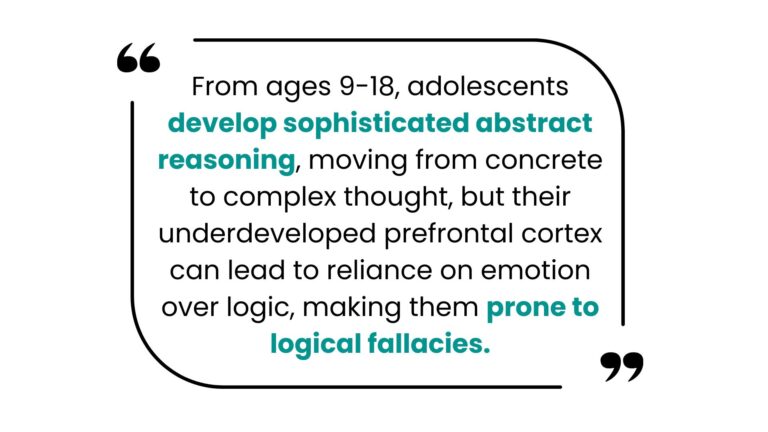
Logical Fallacies Quote: From ages to 9-18, adolescents develop sophisticated abstract reasoning, moving from concrete to complex thought, but their underdeveloped prefrontal cortex can lead to reliance on emotion over logic, making them prone to logical fallacies.

Academic Readiness

From middle school essays to high school debate clubs, these are the formative years for helping students develop strong critical thinking skills. How does instruction in logical fallacies help?

  • Identifying fallacies strengthens writing by avoiding weak arguments.
  • Knowledge of fallacious arguments promotes fair engagement in discussions instead of relying on cheap tricks to win.
  • Students become more adept consumers of information and can more easily recognize the ploys used by others.

Strategies for Teaching Logical Fallacies

1. Introduce the Structure of an Argument

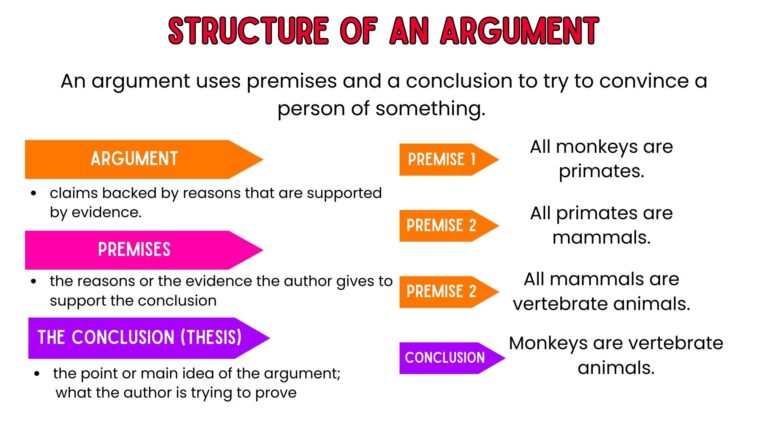
structure of an argument: an argument uses premises and a conclusion to try to convince a person of something.

In simple terms: an argument is like telling a story with a clear point. It has three main parts — a claim (your main idea), the premise(s) (why you believe it and proof to back it up). Then you wrap it up with a conclusion.

This structure makes your argument clear, logical, and persuasive

2. Teach the Difference Between an Argument and a Fight

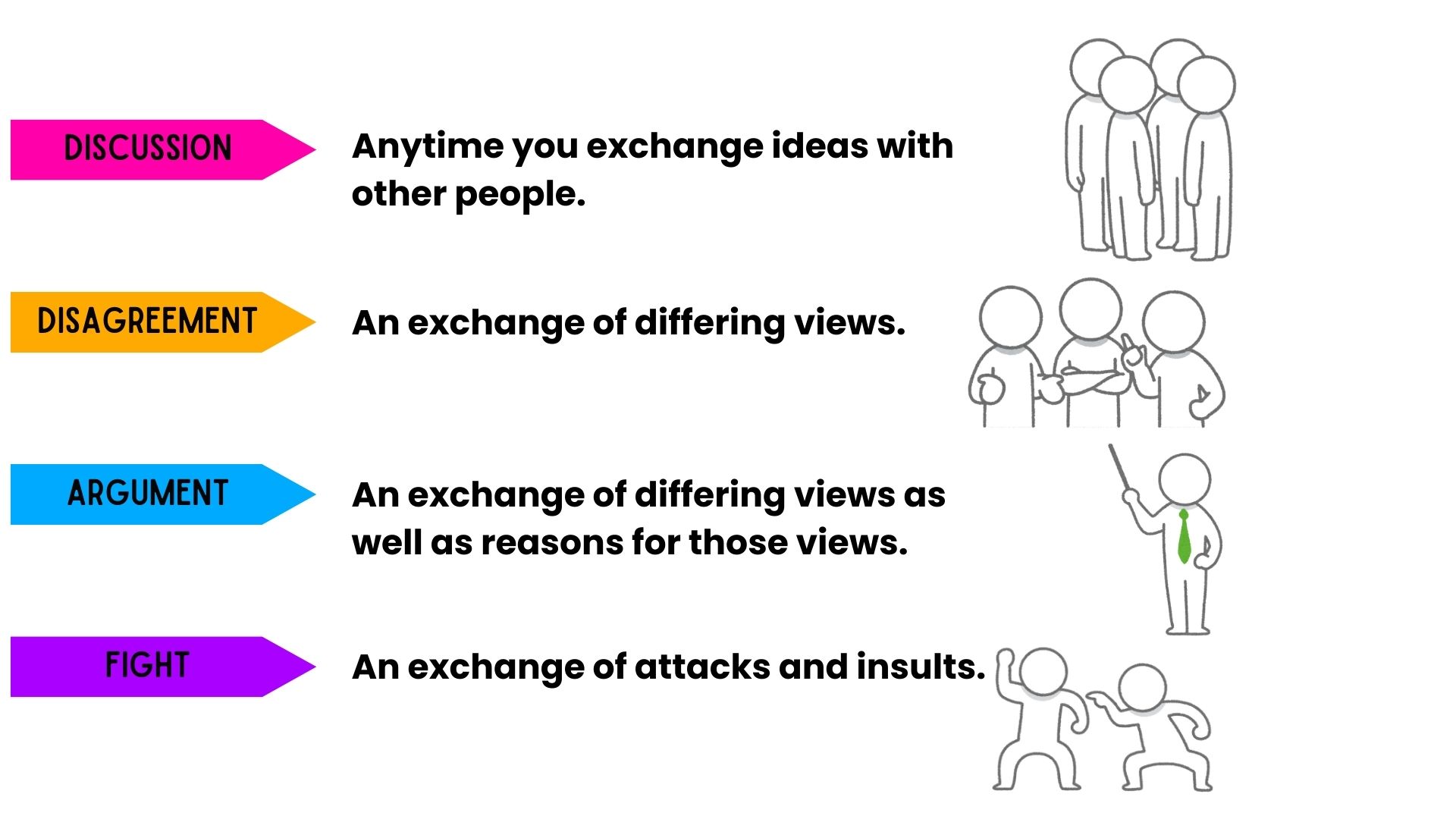
discussion: anytime you exchange ideas with other people; disagreement: an exchange of differing views; argument: an exchange of differing views as well as reasons for those views; fight: an exchange of attacks and insults.

An argument is about persuading with reasons and evidence, while a fight is about defeating or attacking the other person. Teaching students this difference helps them see that debate is about ideas, not hostility, and it sets the stage for understanding fallacies as mistakes in reasoning rather than personal attacks.

When teaching this difference, I also like to include the spectrum above. It helps to build their understanding and vocabulary around encounters they have with differing points of view.

3. Begin With the Most Common Logical Fallacies

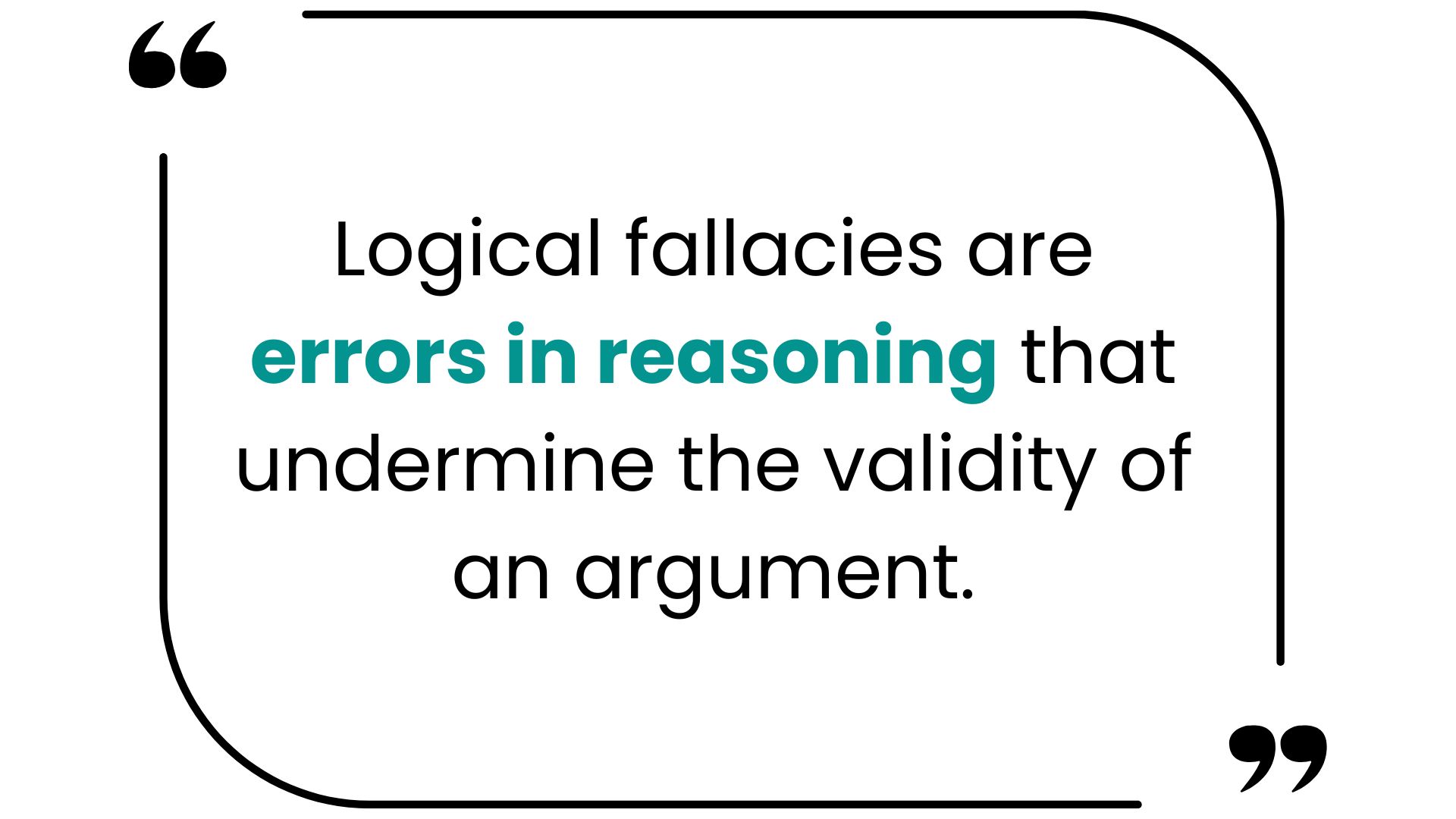
logical fallacies are errors in reasoning that undermine the validity of an argument


Logical fallacies are errors in reasoning that weaken arguments by relying on emotion, distraction, or attack. Because of this, fallacies can make an argument feel like a fight.

And even though they’re errors, logical fallacies have proven to be highly persuasive techniques, which is why, once we know what to look for, we find them everywhere. They are often used in advertising, politics, and social media to sway opinions.

Having the ability to recognize fallacies helps us avoid them in our own arguments, allows us to distinguish truth from falsehood, and builds our resistance to being deceived.  As stated before, learning about logical fallacies has really become and essential life skill.

Following are a few of the most common fallacies students should be introduced to.

What Are Some Common Logical Fallacies to Teach?

image of a red, wooden person and a group of tan, wooden people to represent the logical fallacy bandwagon fallacy.

Ad Hominem – Attacking the person instead of the argument. (“You’re too young to know what you’re talking about.”)

Straw Man – Misrepresenting someone’s position to make it easier to attack. (“You want stricter gun laws? So you want to ban all guns?”)

False Dichotomy – When someone asserts that we must choose between two things when, in fact, there are more options available. (“You’re either with us or against us.”)

Bandwagon – Claiming something is true because many people believe it. (“Everyone’s buying this, so it must be the best.”)

Slippery Slope – When someone claims that a position or decision will lead to a series of unintended negative consequences and an extreme result. (“If we allow students to use phones in class, soon no one will be learning anything!”)

Red Herring – When an irrelevant topic is introduced to an argument. They distract from the main topic. (A police officer gives a driver a ticket for speeding; the driver argues they should be out catching criminals instead of picking on drivers.)

4. Use Real-World Examples of Logical Fallacies

Bringing the real world into lessons on fallacies makes them stick for teens because they can see how flawed reasoning shows up in everyday life—not just in textbooks. It transforms fallacies from abstract definitions into practical tools for navigating media, conversations, and decisions.

While you can bring in examples of the fallacies you introduce in class (especially with younger students), it’s even more meaningful when you issue that challenge to the students. Finding fallacies “in the wild” can really hone a student’s ability to recognize and think logically about the information they encounter on their own.

  • Show TikToks, Instagram posts, or memes that use emotional appeals or false dichotomies.
  • Use commercials or product slogans to identify the fallacy and brainstorm a more honest version of the ad.
  • Bring in headlines or soundbites that oversimplify issues; discuss how fallacies shape public opinion.

Get Started Today!

Incorporating logical fallacy instruction into your classroom is an important step in teaching adolescents to be strong critical thinkers. They deserve to be given all the tools they need to be successful adults.

If we’re teaching the future, let’s make sure we do it right!

Recommended Resource

Looking for a resource that’s ready to print and use today? Try these Logical Fallacy Study Cards featuring 20 common fallacies with definitions, examples, and information on how to counter each fallacy in arguments.  Plus more!

These cards make a great reference deck to get started with your learning.

Leave a Reply

Other Blog Posts

image of girl with traits around her head for character study

How to Study Characters

Understanding the different aspects of a character’s personality, motivation, and transformation can help students better understand all the other elements of a story, as well as the author’s overall message.

Read More »
image of active and passive voice worksheet including a hand holding a pencil

Active and Passive Voice Activities

Understanding active and passive voice can help students write clearer and more effective sentences. It can also help them better comprehend the meaning of what they are reading.

By analyzing the differences between active and passive voice, students can develop critical thinking skills and learn to think more deeply about the language they use.
Read More »
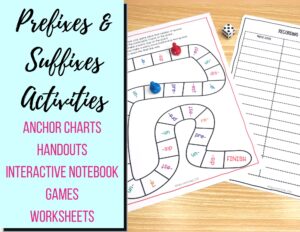
image of prefix and suffix activity freebie. a gameboard and die are on the table.

Prefix and Suffix Activities

Why worry about prefix and suffix activities when there are so many other things to teach? Studying common prefixes and suffixes can have a huge impact on your students’ learning! They become better readers, spellers, and writers. Here are a few simple ideas and activities to supercharge your lessons, keep your students engaged, and make the practice meaningful.
Read More »

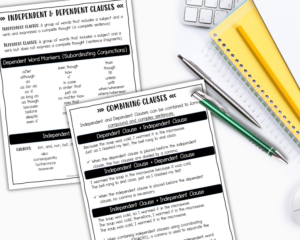
Complex Sentence Strategies

Teaching complex sentence writing to students can be a challenging task. Here are a few simple, but effective strategies you can use to help your students understand and use these sentences effectively.
Read More »
snips-and-snails-teacher-logo-teaching-in-the-classroom

Hi! I'm Rachel

I’m a veteran teacher and homeschooling mom who lives in the Deep South with my husband, two sons, and many pets. I love making learning real for my students and yours!

Join my mailing list here!